I have not ranted a lot but lately the situation has been changing. I have started a new blog at http://tsoots.blogspot.com/ where my intention is to write articles, tutorials and news items in Finnish about free graphics applications. There is no doubt that Scribus will be the most covered one.

Hiiop, Blogi vapaista grafiikkaohjelmista

Hiiopissa kommentoidaan viimeisimpiä uutisia vapailta grafiikkamarkkinoilta. Ohjelmia, jotka näille markkinoille kuuluvat ovat mm. Scribus, Fontmatrix ja Inkscape. Kommenttien lisäksi alan julkaista lyhykäisiä ohjeita kyseisille ohjelmille.

Blogi löytyy osoitteesta: http://tsoots.blogspot.com/

One of the things we have always been quite proud of is the community which has developed around Scribus: the lively and flame free mailing list, the busy and accessable IRC channel on freenode.net and not least the number of user contributions to the wiki, templates and other sample files.

We have never called for financial support for Scribus before. Now we are. There is a simple and easy way to help, not just the Scribus Team, but all the other free and open source graphics applications you probably use with Scribus. Collectively, we and the other teams have organized a community fund drive to help sponsor the costs of the Libre Graphics Meeting.

The Libre Graphics Meeting brings together developers and users of free software graphics applications, such as the GIMP,Inkscape, Scribus, Blender, Krita, the Open Clipart Library and more. For the first time, we are asking the community to help support this meeting.

What is the Libre Graphics Meeting?

In its third edition, the organization needs your help! You can support your favorite graphics application, and ensure that the travel costs of as many volunteer developers as possible are paid to ensure that this edition of the conference is as successful that its predecessors. The conference is May 8 - 11 in Wroclaw, Poland.

Where will the money go?

We have kept costs associated with infrastructure to a minimum. Over 80% of the conference budget will be spent on subsidizing travel and accommodation costs for developers. $20K is the goal to raise by Friday April 18! Already over $ 7000 has been raised in a just a short few days, which is humbling to see so much support so quickly. But our goal has not been reached yet and you can help.

So how does it help Scribus ?

For the team, it is the most important venue for us in the year. It allows us to collaborate with face to face, both as a team and with other teams. A couple of concrete examples:

At the first LGM, Marty Maria of Littlecms gave an excellent overview of color management use for developers. One of the issues we were struggling with was occasional crashes with non-conforming color profiles which were difficult to prevent. During a side session a couple of Scribus developers walked through how Scribus was using littlecms and Marti pointed out some special error checking code he had added to littlecms. He guided us on enabling it and a few days later Scribus now had the “self-defense” code to prevent bad profiles from causing a crash. When the Lprof developers were having the same kind of issue, we pointed them to the new code in Scribus which solved the issue.

During LGM2, we had some informal late night discussions with some Inkscape developers on the importance to add color management into Inkscape. We talked through some of the challenges and also walked through where we could improve SVG import. Since then, Inkscape has made its first foray into color management and Scribus has a more capable SVG importer.

These face to face meets, as we have learned, are vitally important to accelerate the progress of development, which in the end means better applications for everyone. :-)

So how does it work ?

Simply go the Pledgie Page for LGM and make your contribution.

A non-profit organization

All donations will be made to the conference organizers via the GNOME Foundation, a 501(c)3 tax exempt US-based non-profit, so donations will be tax deductible for US taxpayers. We would like to thank the GNOME Foundation for their support.

Thanks for your support!

Well folks the game is on. It is with great pleasure that I announce that we have been accepted into the wonderful Google Summer of Code program for the
second time. My thanks go to all the people from the team and the larger Scribus Community who were involved in preparation of our application and especially
to those who volunteered to be Mentors and Backup Admins. Their names are already immortalized in the wiki team application page history and on our
application page if you’d like to know our heroes.

CALL TO ACTION FOR PROSPECTIVE STUDENT PARTICIPANTS:

We are listing some of ours and accepting your ideas for GSoC projects in our
http://wiki.scribus.net/index.php/GsoC_2008_Ideas wiki. Contact me or other
people on Scribus GSoC 2008 Team to get your wiki login and create a proposed
project page in our wiki starting with the
http://wiki.scribus.net/index.php/GsoC_2008_Scribus_Team_Application#10._Does_your_organization_have_an_application_template_you_would_like_to_see_students_use.3F_If_so.2C_please_provide_it_now.
template we provide. Create your proposal/info page as a child of
http://wiki.scribus.net/index.php/GSoC_2008_Student_Proposals. An example
student information and proposal page is provided at
http://wiki.scribus.net/index.php?title=GsoC_2008_Example_proposal.

Closest timeline milestones for students:
* You should get involved in preparing your application, appearing in #scribus
and on the mailing list, talking to us, discussing your ideas and the proposed
project with us and interested members of the Scribus community as soon as
possible. I mean it. Don’t wait for the last day or there just won’t be enough
time for us to get to know you and to consider your proposal. We want to
help you have a fun and profitable summer, so don’t be shy with us.
* Student application period opens on March 24th at ~12 noon PDT/19:00 UTC.
* You and our GSoC team must be on the same page in relation to your project
proposal between now and the March 31st Student application deadline at 5:00
PM PDT/00:00 UTC April 1, 2008, but the closer you get to the deadline the
more difficult it will be, so don’t wait too long.

Happy Google Summer to all involved!

Oleksandr (Alex.) Moskalenko
Scribus Team’s GSoC 2008 administrator

This is that time of year again. The wonderful folks at Google have announced (http://code.google.com/soc/2008/) that they were running their Summer of Code program again. We at the Scribus Team are quite excited about it in part as one of the two newest additions to our group Hermann Kraus has made his way in through the excellent work he did for us during GSoC 2007 and in part because we had such a great time of it last year. This is a terrific program that brings innumerable benefits to the Open Source ecosystem. We are hoping to be a part of this process this year as well, so we are working on our application and are soliciting ideas for potential GSoC 2008 Scribus Team projects from the larger Scribus Community in our wiki at http://wiki.scribus.net/index.php/GsoC_2008_Ideas. Let the summer of fun and learning begin!

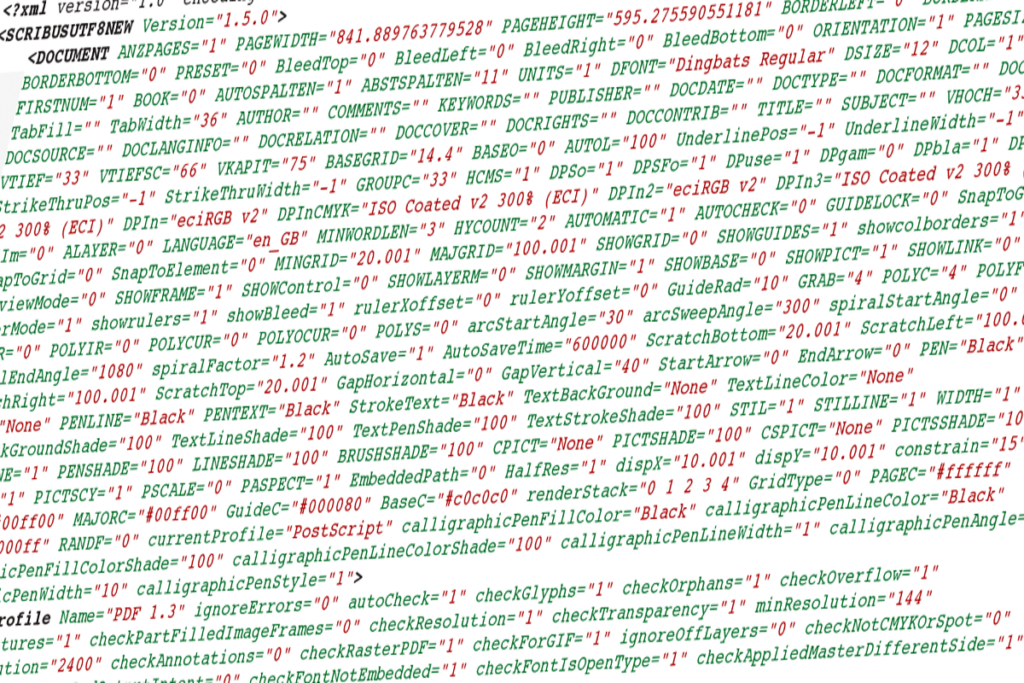
Storing documents in text, in XML, in Scribus to be exact, is a really cool thing. Let me show you a real life example.

(more…)

During the release party for 1.3.3.10 Jean Ghali one of our quietest but steadiest developers (he’s slaughtered a mountain of bugs in 1.3.3.x), noticed that we were about to pass our millionth download on Sourceforge. Which got me thinking…

A million downloads for a project like Scribus. What is the significance ? What does that tell us ?

The technical part: Just shy of 20TB of data. Or looking at the rough averages currently, one person downloading a copy of Scribus every two minutes or so. Two years ago when we started hosting our downloads on Sourceforge we averaged 4.5Gb of data. Now we’re getting close to 2TB some months and the trend is steadily upward.

Moreover, those numbers are actually lower than reality when you consider it only counts downloads of Scribus after 1.2.something and we host a lot of binaries on the OpenSuse Build Server and we also have a separate Debian/Ubuntu repository. Lastly, almost every Linux distro includes Scribus by default.

So, where does that leave us ? What does it tell us ? The plain numbers are kind of dull and boring, but what it represents in the bigger scheme of things is that a complete and very healthy ecosystem has evolved in the area of Free and Open Source graphics applications. You can do serious professional grade publishing reliably using only open source tools.

When Scribus was started there was GIMP and a then sometimes rough on the edges Ghostscript, but not much else. No Inkscape, no Krita, no Fontforge, a dearth of decent professional grade fonts and very few which were really capable beyond Latin and CJK languages. Font managment plain sucked. Keith P. will go to heaven if only for making fontconfig and thus font installation sane on *nix. Early Scribus had all kinds of hacks and code just to find fonts, not any kind of sanity checking or other goodness we can now do with Freetype2.

Which leads us to today, where we can see GIMP getting GEGL and its long promised deep color spaces. Krita2 in a short few months will have a lot of goodness Scribus users will really groove on (and it might be really running stable on Windows.) Inkscape is making its first baby steps in adding color managment and they are really trying to make it work perfectly for Scribus downstream. Lprof, the color profile maker now is cross platform and is getting hardware support for pro grade colorometers.

Even better is the community of people who have emerged around Scribus and other FLOSS graphics apps. We have things like Fontmatrix which I ranted about earlier popping up out of nowhere to complete the scenery. LGM 1 and 2 were great and I fully expect LGM3 to meet or exceed them.

What that million means is are now enjoying what was just something we could only dream of when Scribus 0.2 (~ 150 downloads) was so modestly launched in 2001.

One of the things which is perceived as a stumbling block to using Linux as a designer’s platform is the lack of font management tools. Most graphics professionals started or at some time worked on a Mac and often enough MacOS 9 or earlier.

So, while font management is nowhere as difficult on Linux as it might be assumed since the arrival of Keith Packard’s fontconfig, it is a perception thing. Moreover, KDE3 for a while, now has a simple and very effective font manager/installer called Kfontinstaller. I have commented elsewhere that I think it is the simplest and most user GUI friendly font manager on any platform. It is a font manager with no extra bells and whistles. To boot, Linux can run with lots of fonts installed with no large performance hit - unlike earlier graphics apps and older Windows versions.

Getting back to Macs, and in my experience with production workstations on Win32 , a 100% certainty was the need for a third party font manager. Most of the time either Suitcase or ATM sufficed. They made it manageable to use and select from more than a few hundred fonts.

Plus, fonts on pre-OSX Macs had a nasty tendency to corrupt themselves every once and a while. Most of the older font managers had tools to try and fix this too. Something which one should never worry about happening on Linux. ;-) As you can imagine over time doing layout professionally you tended to end up with hundreds if not thousands of fonts installed. Not good for performance and a nightmare to manage without third party tools.

Given all that, one can see why graphics and layout folks are asking: “Where is the font manager ?” In a sign of the increasing maturity of open source as a graphics platform, there is now a real font manager built with the kind of features and abilities graphic designers, layout pros. along with others have felt necessary, but modernized with some new touches. Introducing Fontmatrix. :-)

fontmatrix1.png

One thing where Fontmatrix has the older proprietary managers beat is the concept of ‘tagging’. This makes it really nice to group fonts and even sub-group them logically for use in say a book. It also has extensive support to give you a nice gui to show all the glyphs in a font, previews of sample text, variable sizing and also tell you what kinds of advanced Open Type features are inside the guts of your font. That is something I’ve never seen outside of a font editor. And not least, it creates a nice PDF catalogue of your fonts for printing or reference. All in all, a real pro’s font manager, but still nice and user friendly.
Fontmatrix is still young, but it does not crash for me and it works really well already. For installing ease, I have packaged it for Suse 10.2+ and Fedora 8 on the OpenSuse Build Service which I have talked about before. Enjoy.

Today marks a big achievement in the development of Scribus 1.3.5. As of now, we no longer use Qt3 or its support classes. YAY. A big job - one that started out as very simple but right at the end took awhile to get finalised. Its a nice feeling to have that sorted and now we can get on with stabilising the other changes and heading towards a release (not imminent, but approaching at least).

This is just a quick update of the ongoing LGM2 in Montreal. Some last minute complications prevented all the Scribus team members from being here, but LGM2 has been an excellent meet so far. In brief:

  • We have announced the latest release of 1.3.3.9, 1.3.4 and the first public demo of 1.3.5, the port of Scribus to Qt4. The port is not complete, but Scribus compiles, loads documents and runs under Qt 4.2. Packages and source will available soon.
  • We saw Raphael from LeTigre give an excellent talk about how LeTigre has been produced using 100% FLOSS graphics applications.
  • The Krita developers give a well organized talk about the future of their painting/image editing application.
  • Louis Soares-Potts gave a presentation about the importance of Open Document format. We had a very interesting conversation about how ODF is used with Scribus and how we can better use ODF for not only import, but export for some use case our future plans with ODF.
  • The GIMP team has shown up en masse and we have had a bit more time to chat together informally. I hear the gimp developers want gimp 2.4 be out very very soon.

This list is far from complete and more to come…. Montreal has been a great host city.

Scribus Team got two project slots for Google Summer of Code 2007. We had 7 applications and coming up with two selections really wasn’t easy. I’d like to thank all students who applied to the program whether selected or not. You guys make it fun. The selected projects are Imposition plugin, which is our number 1 user requested feature addition, and Math Support. The students who are going to be working on these projects are Mateusz Haligowski and Hermann Kraus. Mentors for these projects are Riku Leino (Tsoots) and Andreas Vox (Avox) with assistance from other dev. team members, of course.
Let’s get the coding going and hopefully everybody invoved will have a fun summer!
Oh, and don’t forget the cool T-Shirts!

Next Page »